
Table of Contents
I still remember the moment I truly understood what marketing was. It wasn’t in a classroom or from a textbook—it was when I watched a small coffee shop transform from struggling to survive into the neighborhood’s favorite gathering spot. The owner didn’t change the coffee. She didn’t renovate the space. She simply started telling her story, connecting with customers on social media, and creating experiences people wanted to share. That’s when it clicked: marketing isn’t about selling; it’s about creating meaningful connections that naturally lead to business growth.
In 2025, marketing has evolved into one of the most dynamic and essential functions of any successful business. Whether you’re a seasoned professional or just starting your journey, understanding what marketing truly encompasses is crucial for navigating today’s competitive landscape.
Key Takeaways
- 📊 Marketing is a strategic process that identifies customer needs, creates value, and builds lasting relationships—not just advertising or sales
- 🎯 The marketing mix (4 Ps) provides a foundational framework: Product, Price, Place, and Promotion work together to deliver customer value
- 💡 Modern marketing is customer-centric, focusing on understanding and solving real problems rather than pushing products
- 🔄 Digital transformation has revolutionized how businesses connect with audiences through data-driven, personalized experiences
- 🚀 Successful marketing strategies combine traditional principles with innovative approaches to create sustainable competitive advantages
Understanding Marketing: More Than Just Advertising
When most people hear the word “marketing,” they immediately think of advertisements, commercials, or social media posts. While these are certainly components of marketing, they represent only a small fraction of what marketing actually encompasses.
Marketing is the strategic process of creating, communicating, delivering, and exchanging offerings that have value for customers, clients, partners, and society at large. It’s the bridge between what a business offers and what customers actually need or want.
Think of marketing as the entire journey—from understanding what keeps your customers up at night, to developing solutions that address those concerns, to ensuring they know your solution exists, and finally, to creating experiences so remarkable that they tell others about it.
The Evolution of Marketing Through the Ages
Marketing has transformed dramatically over the decades:
- 1950s-1960s: Product-focused era where “build it and they will come” prevailed
- 1970s-1980s: Sales-oriented approach emphasizing persuasion and transaction completion
- 1990s-2000s: Customer-centric shift focusing on relationships and retention
- 2010s-Present: Digital revolution enabling personalization, data analytics, and real-time engagement
- 2025 and Beyond: AI-powered, experience-driven marketing with emphasis on authenticity and social responsibility
The Core Components of Marketing
Marketing isn’t a single activity—it’s an interconnected ecosystem of strategies, tactics, and principles working in harmony. Let me break down the essential elements that every marketer should understand.
The Marketing Mix: The 4 Ps Framework
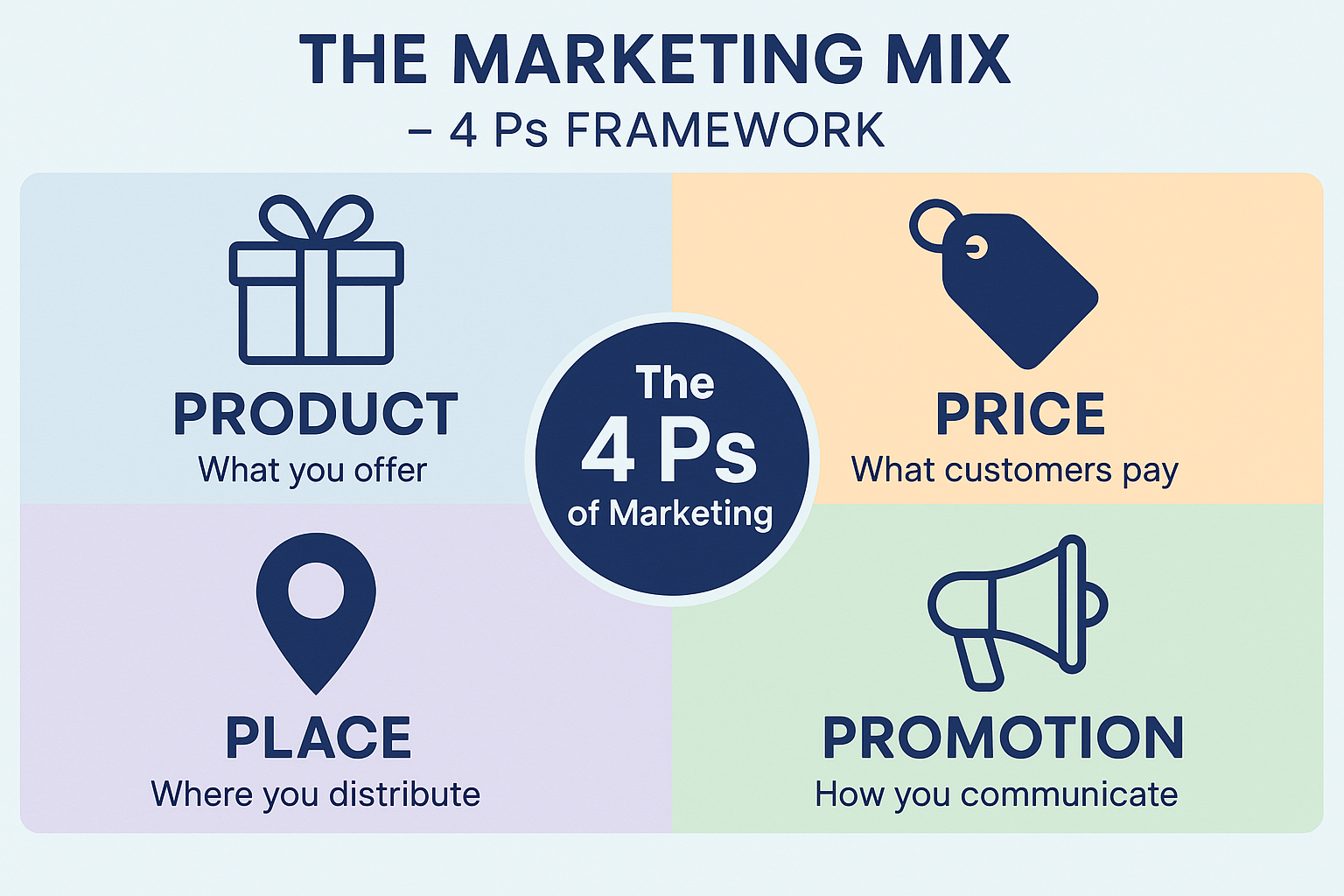
The traditional marketing mix, also known as the 4 Ps, remains a cornerstone concept:
| Component | Definition | Key Questions |
|---|---|---|
| Product 🎁 | The goods or services you offer | What problems does it solve? What features matter most? |
| Price 💰 | The amount customers pay | What’s the perceived value? How does it compare to competitors? |
| Place 📍 | Distribution channels and locations | Where do customers shop? How do they prefer to buy? |
| Promotion 📢 | Communication and awareness strategies | What message resonates? Which channels reach your audience? |
In modern marketing, many professionals expand this to the 7 Ps, adding:
- People: Everyone involved in the customer experience
- Process: The systems and workflows that deliver value
- Physical Evidence: Tangible proof of service quality
Market Research: The Foundation of Smart Decisions
I’ve witnessed countless businesses fail because they assumed they knew what customers wanted without actually asking. Market research is the systematic gathering, recording, and analysis of data about customers, competitors, and market conditions.
Effective market research includes:
- Primary research: Surveys, interviews, focus groups, and direct customer feedback
- Secondary research: Industry reports, competitor analysis, and market trend studies
- Quantitative data: Numbers, statistics, and measurable metrics
- Qualitative insights: Emotions, motivations, and behavioral patterns
“Marketing without data is like driving with your eyes closed.” — Dan Zarrella
Types of Marketing: Finding Your Strategic Approach
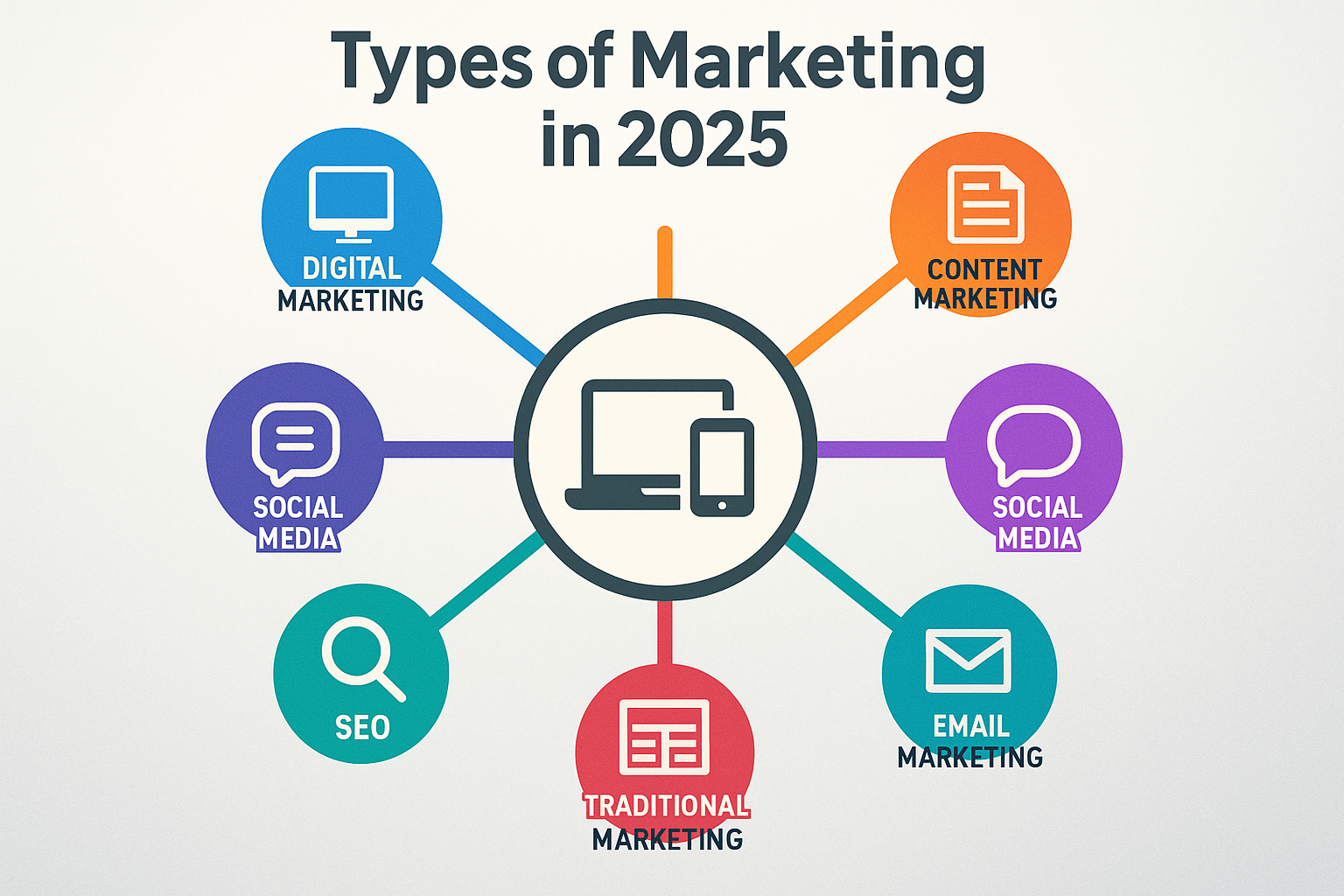
The marketing landscape in 2025 offers diverse approaches, each with unique strengths and applications. Understanding these different types helps you build a comprehensive strategy tailored to your specific goals.
Digital Marketing: The Modern Imperative
Digital marketing encompasses all marketing efforts that use electronic devices or the internet. It’s no longer optional—it’s essential for business survival.
Key digital marketing channels include:
- Search Engine Optimization (SEO) 🔍: Improving organic visibility in search results
- Content Marketing ✍️: Creating valuable content that attracts and engages audiences
- Social Media Marketing 📱: Building communities and conversations on platforms like LinkedIn, Instagram, and TikTok
- Email Marketing 📧: Nurturing relationships through targeted, personalized messages
- Pay-Per-Click (PPC) 💳: Paid advertising on search engines and social platforms
- Influencer Marketing 🌟: Partnering with influential voices to reach new audiences
Traditional Marketing: Still Relevant in 2025
Despite the digital revolution, traditional marketing channels continue to deliver value, especially when integrated with digital strategies:
- Print advertising: Magazines, newspapers, brochures
- Broadcast media: Television and radio commercials
- Direct mail: Postcards, catalogs, letters
- Outdoor advertising: Billboards, transit ads, signage
- Event marketing: Trade shows, conferences, sponsorships
Relationship Marketing: Building Long-Term Value
I’ve learned that acquiring a new customer costs 5-25 times more than retaining an existing one. Relationship marketing focuses on creating long-term customer loyalty rather than short-term transactions.
This approach emphasizes:
- Exceptional customer service and support
- Personalized communication and offers
- Loyalty programs and exclusive benefits
- Community building and engagement
- Continuous value delivery beyond the initial sale
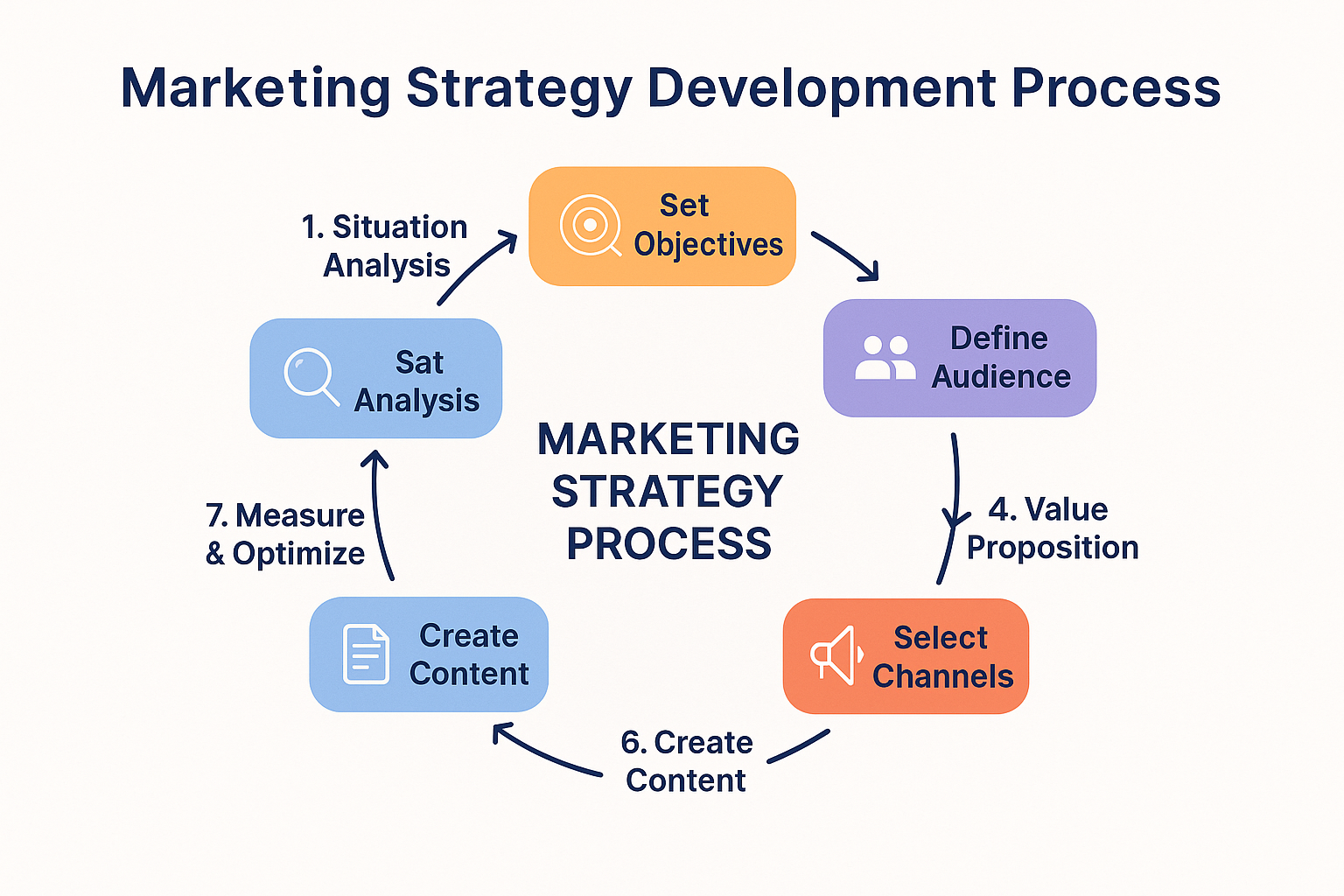
The Marketing Strategy Development Process
Creating an effective marketing strategy requires systematic planning and execution. Here’s the framework I use when developing comprehensive marketing strategies:
Step 1: Situation Analysis
Begin by understanding where you currently stand:
- SWOT Analysis: Identify Strengths, Weaknesses, Opportunities, and Threats
- Competitive landscape: Who are your competitors and what are they doing?
- Market trends: What changes are shaping your industry?
- Customer insights: What do you know about your target audience?
Step 2: Define Clear Objectives
Set SMART goals (Specific, Measurable, Achievable, Relevant, Time-bound):
- ❌ Vague: “Increase brand awareness”
- ✅ SMART: “Increase website traffic by 40% within six months through SEO and content marketing”
Step 3: Identify Target Audiences
Create detailed buyer personas representing your ideal customers:
- Demographics (age, location, income, education)
- Psychographics (values, interests, lifestyle)
- Behavioral patterns (buying habits, media consumption)
- Pain points and challenges
- Goals and aspirations
Step 4: Develop Your Unique Value Proposition
What makes your offering different and better? Your value proposition should clearly articulate:
- The specific problem you solve
- How you solve it differently than competitors
- The tangible benefits customers receive
- Why they should choose you over alternatives
Step 5: Select Marketing Channels and Tactics
Choose the channels where your target audience spends time and that align with your resources. I’ve found that it’s better to excel on three channels than to spread yourself thin across ten.
Step 6: Create a Content and Messaging Strategy
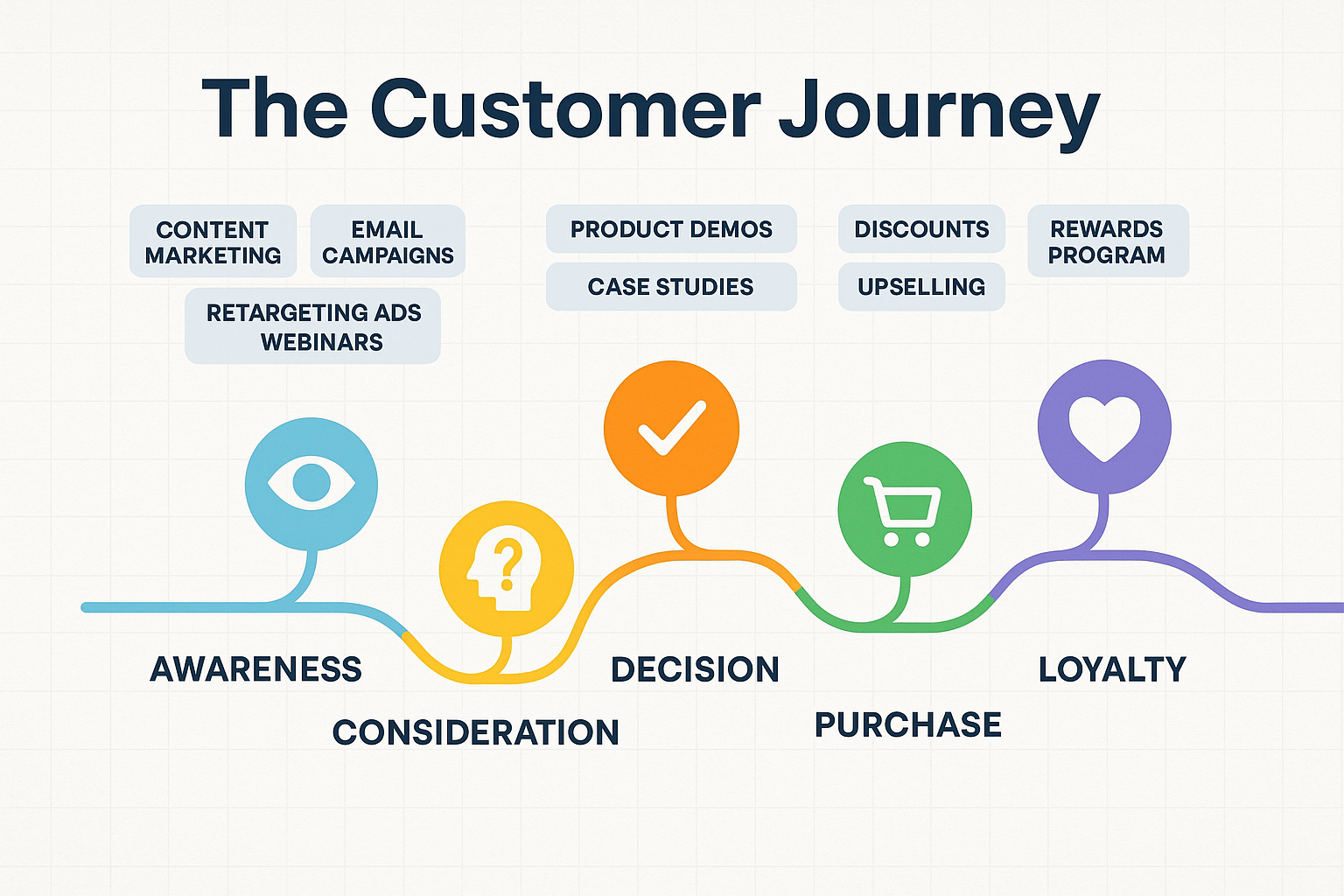
Develop compelling content that resonates with your audience at each stage of their journey:
- Awareness stage: Educational content that addresses pain points
- Consideration stage: Comparative information and case studies
- Decision stage: Product details, testimonials, and offers
- Retention stage: Ongoing value, support, and community
Step 7: Implement, Measure, and Optimize
Launch your campaigns and continuously monitor performance using key performance indicators (KPIs):
- Website traffic and engagement metrics
- Conversion rates and customer acquisition costs
- Return on investment (ROI) and return on ad spend (ROAS)
- Customer lifetime value (CLV)
- Brand awareness and sentiment metrics
The Psychology Behind Effective Marketing
Understanding human behavior and decision-making processes is crucial for marketing success. Here are key psychological principles that influence consumer behavior:
The Power of Storytelling
Humans are hardwired for stories. We remember narratives 22 times more than facts alone. Effective marketing weaves products and services into compelling stories that:
- Create emotional connections
- Make complex concepts relatable
- Build trust through authenticity
- Inspire action through identification
Social Proof and Influence
People look to others when making decisions. Leverage social proof through:
- Customer testimonials and reviews
- Case studies and success stories
- User-generated content
- Influencer endorsements
- Trust badges and certifications
Scarcity and Urgency
Limited availability or time-sensitive offers trigger fear of missing out (FOMO), encouraging faster decision-making. However, use this ethically—artificial scarcity damages trust.
The Principle of Reciprocity
When you provide value first (free content, tools, samples), people feel compelled to reciprocate. This is why content marketing and lead magnets work so effectively.
Marketing in the Age of AI and Automation
As we navigate through 2025, artificial intelligence and automation are fundamentally reshaping marketing practices. I’ve witnessed firsthand how these technologies enhance rather than replace human creativity.
AI-Powered Personalization
Modern consumers expect personalized experiences. AI enables:
- Dynamic content customization based on behavior
- Predictive analytics for anticipating customer needs
- Chatbots providing instant, 24/7 customer support
- Automated email sequences triggered by specific actions
Marketing Automation Platforms
Tools that streamline repetitive tasks allow marketers to focus on strategy and creativity:
- Lead nurturing workflows
- Social media scheduling and posting
- Campaign performance tracking
- Customer segmentation and targeting
Data-Driven Decision Making
The ability to collect and analyze vast amounts of data has transformed marketing from guesswork to science. Successful marketers in 2025:
- Use analytics to understand customer journeys
- Conduct A/B testing to optimize campaigns
- Monitor real-time performance metrics
- Make data-informed strategic adjustments
Building a Career in Marketing
For those considering a marketing career, the field offers diverse opportunities and pathways. The marketing profession has evolved into a multifaceted discipline requiring both creative and analytical skills.
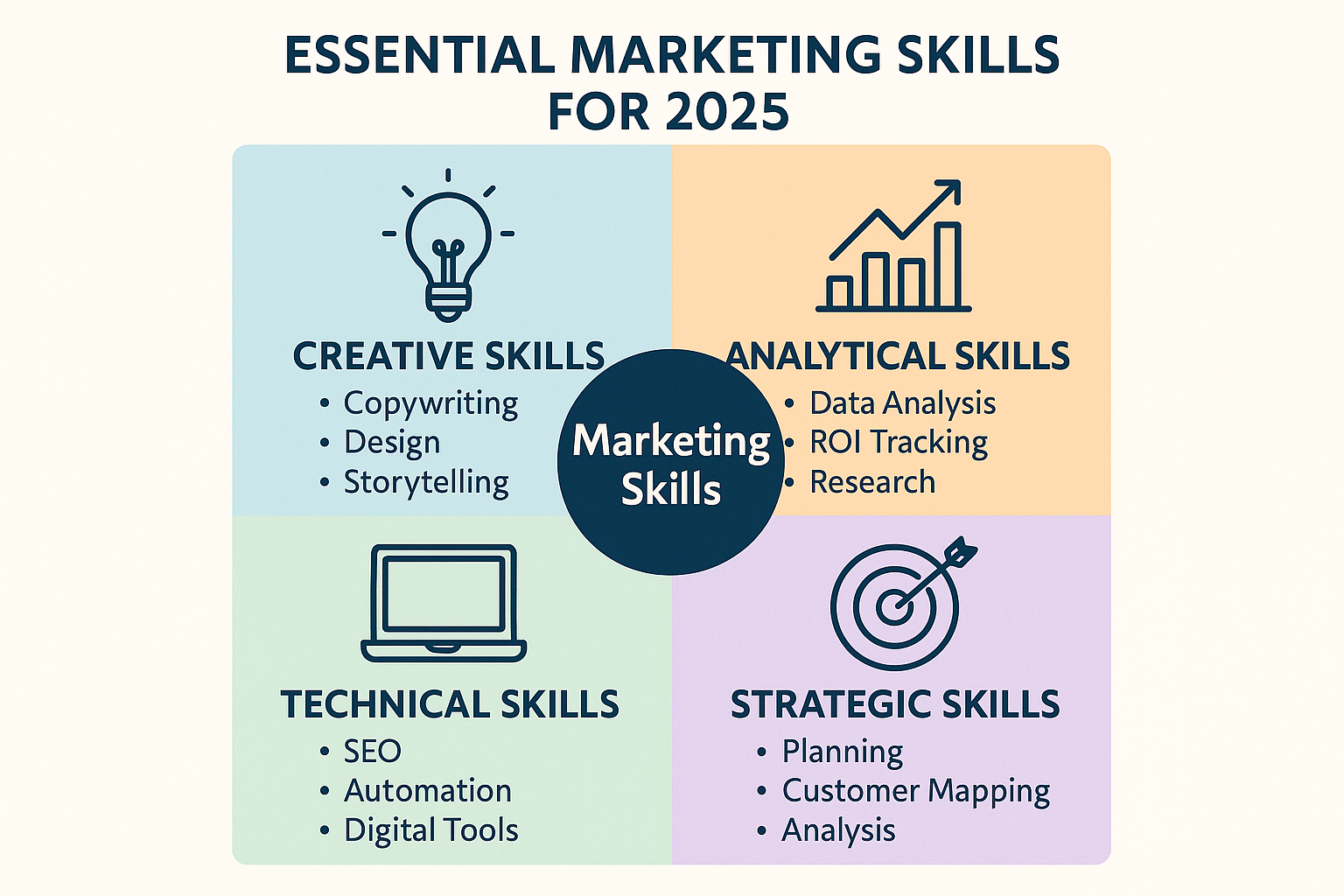
Essential Marketing Skills for 2025
To thrive in modern marketing, develop these core competencies:
Creative Skills 🎨:
- Copywriting and content creation
- Visual design and brand development
- Storytelling and messaging
- Creative problem-solving
Analytical Skills 📊:
- Data analysis and interpretation
- Performance measurement and reporting
- Market research and consumer insights
- ROI calculation and budget management
Technical Skills 💻:
- Digital marketing platforms and tools
- SEO and SEM fundamentals
- Marketing automation systems
- Basic HTML/CSS and content management systems
Strategic Skills 🎯:
- Strategic planning and execution
- Customer journey mapping
- Competitive analysis
- Cross-functional collaboration
Marketing Career Paths
The field offers numerous specialization opportunities:
- Digital Marketing Manager: Oversees online marketing initiatives
- Content Strategist: Plans and manages content creation
- SEO Specialist: Optimizes organic search visibility
- Social Media Manager: Builds and engages online communities
- Brand Manager: Maintains brand consistency and equity
- Marketing Analytics Manager: Interprets data to guide strategy
- Product Marketing Manager: Positions and launches products
- Chief Marketing Officer (CMO): Leads overall marketing strategy
Common Marketing Mistakes to Avoid
Throughout my career, I’ve observed patterns in marketing failures. Here are pitfalls to avoid:
1. Focusing on Features Instead of Benefits
Customers don’t buy products—they buy solutions to their problems and better versions of themselves. Always translate features into meaningful benefits.
2. Ignoring the Customer Journey
Marketing isn’t a single touchpoint. Map the entire customer experience from awareness to advocacy, ensuring consistency at every stage.
3. Neglecting Existing Customers
While acquiring new customers is important, retaining and expanding relationships with current customers typically delivers higher ROI.
4. Inconsistent Brand Messaging
Your brand should communicate consistently across all channels. Inconsistency creates confusion and erodes trust.
5. Failing to Track and Measure Results
What gets measured gets improved. Establish clear metrics and regularly analyze performance to optimize your efforts.
6. Trying to Appeal to Everyone
The riches are in the niches. Attempting to serve everyone dilutes your message and wastes resources. Focus on your ideal customer.
The Future of Marketing: Trends Shaping 2025 and Beyond
As we move through 2025, several trends are reshaping the marketing landscape:
Privacy-First Marketing
With increasing data privacy regulations and consumer concerns, successful marketers are building first-party data strategies and earning customer trust through transparency.
Authentic, Purpose-Driven Brands
Consumers, especially younger generations, increasingly support brands that align with their values and demonstrate genuine social responsibility.
Interactive and Immersive Experiences
From augmented reality (AR) try-ons to virtual events, brands are creating engaging experiences that go beyond passive content consumption.
Voice and Visual Search Optimization
As search behavior evolves, optimizing for voice queries and visual search becomes increasingly important.
Community-Centric Marketing
Building engaged communities around shared interests and values creates stronger customer relationships than traditional advertising.
Sustainability and Ethical Marketing
Environmental consciousness and ethical business practices are no longer optional—they’re expected by informed consumers.
Practical Steps to Improve Your Marketing Today
Ready to enhance your marketing efforts? Here are actionable steps you can implement immediately:
- Audit your current marketing activities: Identify what’s working and what’s not
- Survey your customers: Ask what they value most and where they discover solutions
- Optimize your website for conversions: Ensure clear calls-to-action and user-friendly navigation
- Develop a content calendar: Plan consistent, valuable content delivery
- Set up analytics tracking: Implement tools to measure your marketing performance
- Test one new channel: Experiment with a platform you haven’t fully explored
- Review your brand messaging: Ensure it clearly communicates your value proposition
- Create a customer referral program: Leverage your satisfied customers to attract new ones
If you need guidance on implementing these strategies, feel free to reach out to our team for personalized support.
Conclusion: Marketing as a Continuous Journey
Marketing is not a destination—it’s an ongoing journey of learning, adapting, and connecting with people in meaningful ways. As we’ve explored throughout this guide, effective marketing combines art and science, creativity and analytics, strategy and execution.
The most successful marketers I know share common traits: curiosity about human behavior, adaptability in the face of change, commitment to continuous learning, and empathy for the people they serve.
Whether you’re building a personal brand, growing a small business, or leading marketing for a large organization, the fundamental principles remain constant: understand your audience, deliver genuine value, communicate authentically, and measure your results.
Your Next Steps
To continue your marketing education and implementation:
- Subscribe to industry publications and thought leaders to stay current with trends
- Experiment with new tactics on a small scale before full implementation
- Network with other marketing professionals to exchange ideas and experiences
- Invest in ongoing education through courses, certifications, and conferences
- Review and update your marketing strategy quarterly to ensure alignment with business goals
Remember, every expert marketer started exactly where you are now. The difference between those who succeed and those who don’t isn’t talent—it’s persistence, willingness to learn from failures, and commitment to serving customers better each day.
For more insights on building effective business strategies, explore our comprehensive resources designed to help you grow. And if you have questions or want to share your marketing journey, don’t hesitate to get in touch—I’d love to hear from you.
Marketing in 2025 offers unprecedented opportunities to create impact, build meaningful connections, and drive business growth. The question isn’t whether marketing matters—it’s how you’ll use these principles to make a difference in your corner of the world.
Disclaimer: The information provided in this article is for educational purposes. Marketing strategies should be tailored to your specific business context and goals. For specific advice, please review our disclaimer and terms and conditions. We respect your privacy and are committed to protecting your data.
🎯 Marketing Strategy Builder
Answer these questions to create a customized marketing strategy framework